Wa-pedia.com
FORUM GALLERY BOOKS TRAVEL LIFE & WORK SOCIETY CULTURE LANGUAGE NEWS FRIENDS
POLITICS ECONOMY STATISTICS EXPAT ISSUES TRADITIONAL CULTURE POP CULTURE RELIGION HISTORY TRIVIA
Bookmark and Share
Site NavigationWa-pedia Top> Japan Glossary

Glossary of Japanese Terms

The articles in this section were written by Maciamo except otherwise mentioned

Cultural & Historical Terms

For food, culinary and cooking terms, check the Japanese Food Glossary

  • AEON
    One of the largest foreign language school in Japan. Known as one of the "big 5" Eikaiwa school, along with GEOS, NOVA, ECC and Berlitz. Also the name of a famous supermarket (AEON JUSCO).
  • Amaterasu Omikami
    Supreme Shintō goddess of the Sun, and legendary ancestor of the Japanese Imperial family.
  • ANA
    All Nippon Airways
  • Asobu
    "To play". Does not refer only to games, but to any form of entertainment or amusment, including sex.
  • AV
    Adult video (not "audio video" !)
  • Baikingu
    Smorgasbord or buffet. The word comes from "viking", the name of the first Swedish restaurant in Japan offering smorgasbord.
  • Baka
    Term meaning "stupid" or "idiot".
  • Bakumatsu
    Final years of the Tokugawa shogunate (1853-1867), from the arrival of Commodore Perry to the Meiji Restoration.
  • Berlitz
    One of the largest foreign language school in Japan. Known as one of the "big 5" Eikaiwa school, along with GEOS, NOVA, AEON and ECC.
  • Bosan
    See "o-bosan"
  • Chan
    Suffix used after a person name to show familiarity.
  • Choshu
    Former name of Yamaguchi prefecture.
  • Chūbu
    Region of central Honshu, between the Kanto and Kansai. It includes the Koshin'etsu and Tokai areas.
  • Chūgoku
    Western Honshu region.
  • Combini
    24h/7days convenience store, such as 7 Eleven, Family Mart or Circle K-Sunkus.
  • Commodore Perry
    See "Perry"
  • Dashi
    Festival car used in "matsuri".
  • Denka
    Suffix used after a person name, meaning "Your Highness".
  • Dono
    Suffix used after a person name to show respect (more formal than "san" and "sama").
  • ECC
    One of the largest foreign language school in Japan. Known as one of the "big 5" Eikaiwa school, along with GEOS, NOVA, AEON and Berlitz.
  • Echigo
    Former name of Niigata prefecture.
  • Echizen
    Former name of Fukui prefecture.
  • Edo
    Former name of Tokyo until 1868.
  • Eikaiwa
    English Conversation (School). The 5 biggest "Eikaiwa schools" in Japan are : NOVA, GEOS, AEON, Berlitz and ECC.
  • Enjo Kosai
    Literally "compensated dating". It stands for teenage girl who give sexual service to older men, typically in exchange for brand bags or clothes or for money. It is in other words voluntary teenage prostitution and is saddly relatively common in Japan.
  • Enkai Kibun
    "Party mood".
  • Fundoshi
    Loincloth used by "sumo-tori".
  • Furigana
    Hiragana used to give the phonetic reading of kanji.
  • Furo
    See "o-furo"
  • Fusuma
    Sliding door typically made of thick paper or cloth pasted on a wooden frame and used in traditional Japanese houses as room-dividers.
  • Geisha
    Traditional Japanese hostess. Geisha entertain their guests with convresation, games and playing the shamisen, dancing and singing.
  • GEOS
    One of the largest foreign language school in Japan. Known as one of the "big 5" Eikaiwa school, along with AEON, NOVA, ECC and Berlitz.
  • Happi
    Traditional garment worn in "matsuri".
  • Harakiri
    Ritual suicide. Usually called seppuku by the Japanese.
  • Heika
    Suffix meaning "Your Majesty".
  • Heisei
    Current Emperor of Japan since 1989, also known as Akihito.
  • Hiragana
    Japanese phonetic script mostly used for words with no kanji or instead of kanji.
  • Hokkaido
    Japan northenmost major island and second largest island after Honshu.
  • Honshu
    Japan's main island. It includes the region of Tohoku, Kanto, Chūbu, Kansai and Chūgoku.
  • Inari
    Shintō goddess of rice and fertility, usually associated with foxes.
  • Ijime
    Bullying or teasing, usually at school or at work.
  • Ikebana
    Japanese flower arragement.
  • Irasshaimase
    Expression used to welcome customers into a shop or restaurant.
  • Itadakimasu
    Polite expression used before eating, drinking or receiving a present. Lit. means "I humbly receive".
  • Ito Hirobumi
    Leading Meiji-era statesman and first prime minister of Japan.
  • Izakaya
    Restaurants serving various kind of food and where people usually go to drink alcohol.
  • JAL
    Japan Airlines
  • Jigoku
    Hell, as in "jigoku onsen" ("hellish hotspring"). See Beppu
  • Jimintō
    "Jiyu-Minshu-to" (Liberal Democratic Party, or LDP). The largest Japanese political party, in power since 1958. (See Japan's Political System)
  • Jitensha
    Bicycle
  • JNTO
    Japan National Tourist Organization
  • Jōdō-shinshu
    "True Pure Land". Second most popular sect of Japanese Buddhism with about 12 million followers.
  • Jōdō-shū
    "Pure Land". Most popular sect of Japanese Buddhism with about 30 million followers.
  • JR
    Japan Railway
  • JTB
    Japan Travel Bureau (Japan's largest travel agency)
  • Jushoku
    Title given to resident minister of Buddhist temples.
  • JYHA
    Japanese Youth Hostel Association
  • Kami
    Kami is the Japanese word referring to gods, deities or higher powers.
  • Kabakura
    Japanaese abbreviation for "Cabaret Club", i.e. a kind of hostess bar with usually younger girls than in other hostess bars.
  • Kabuki
    Traditional Japanese theatre.
  • Kamameishi
    Rice cooked in an iron pot, usually with vegetable and meat.
  • Kami
    Shintō deity.
  • Kamon
    Traditional family crest of the aristocracy. Also called "Monsho" or just "Mon".
  • Kampai
    "Cheers !"
  • Kampo
    Chinese herbal medicines (still commonly used in Japan in addition to Western medicines)
  • Kana
    The two Japanese phonetic scripts (hiragana and katakana).
  • Kanji
    Chinese character
  • Kannon
    Buddhist/Hindu goddess of Mercy (Sanskrit : Avalokiteshvara).
  • Kannushi
    Head priest of a Shintō shrine.
  • Kansai
    Literally, region "West to the barrier", referring to the major population centre of Western Japan around Kyōto and Osaka. Another term for Kinki.
  • Kanto
    Large plain and geographical area surrounding Tokyo.
  • Katakana
    Japanese phonetic script used mostly for writing foreign words.
  • KDDI
    Kokusai Denshin Denwa International (International Telegraph & Telephone)
  • Keigo
    Honorific language, used to show respect to superiors or elders.
  • Keiretsu
    Industrial conglomerate. Another term for "zaibatsu".
  • Kimono
    Traditional Japanese dress. It is a long, loose robe with wide sleeves tied with a "obi". Kimonos are worn especially for formal ceremonies, mostly by children and women.
  • Kinki
    Literally, region "near the capital (Kyoto)", referring to the prefecture surrounding Kyoto. Another term for Kansai.
  • Koban
    Police box keeping only a few (sometimes only one) police officer. They were created to ensure public order, but are used mostly by people to ask their way around.
  • Kohai
    Term used to refer to a person who is younger or one's subordinate in the same company, school or organization. (Opposite = "sempai")
  • Kombini
    See "combini".
  • Komeitō
    Clean Government Party. Third largest political part in Japan, affiliated to the "new religion" Soka Gakkai. (See Japan's Political System)
  • Konnyaku
    Gelatin-like food made from the starch of "konnyaku potato".
  • Koshinetsu
    Subregion of the Chūbu region. It includes the prefectures of Yamanashi, Nagano and Niigata.
  • Kotatsu
    Low, heated table with a quilt covering it to keep one's body warm. Note that central heating and thermic insulation are still a rarity in Japan.
  • Koto
    Traditional 13-stringed instrument played flat on the floor.
  • Kun
    Suffix used after a person name (usually boys or young men) to show respect.
  • Kyakusan
    Term with a broad meaning in English, meaning guest, customer, passenger, patron, buyer, shopper, regular, clientele, etc.
  • Kyushu
    Japan's third largest island.
  • LDP
    See "Jimintō "
  • Maiko
    Apprentice geisha. They usually dress more colourfully and with more hair ornaments than geisha.
  • Manga
    Japanese comics
  • Mazakon
    Japanese abbreviation for "mother-complex" (Oedipus complex).
  • Meiji
    Emperor of Japan from 1868 to 1912, also known as Mutsuhito.
  • Meiji Restoration
    Historical period coinciding with the Westernization and industrialization of Japan.
  • Miai
    See "o-miai"
  • Miko
    Shrine maiden
  • Mikoshi
    Portable shrine used in festivals.
  • Minshuku
    Japanese-style hostel or Bed & Breakfast.
  • Minshūtō
    Democratic Party of Japan (DPJ). Second largest political party in Japan. (See Japan's Political System)
  • MITI
    Ministry of International Trade and Industry
  • Miyage
    See "o-miyage"
  • Momiji
    Japanese maples (with smaller leaves than other maples), known for their beautiful red leaves in autumn.
  • Momo
    Peach, peach tree or peach blossom.
  • Nampa
    A playboy or playgirl. Someone who is looking for a sexual partner in the street or in a nightclub.
  • NHK
    Nihon Hoso Kyokai (Japan Broadcasting Corporation). The Japanese equivalent of the BBC.
  • No pants shabu-shabu
    "Shabu-shabu" restaurant where waitresses do not wear underwear and perverted customers are allowed to peep under their skirts. Also exist with other kinds of restaurants than "shabu-shabu".
  • NOVA
    The largest foreign language school in Japan. Known as one of the "big 5" Eikaiwa school, along with AEON, GEOS, ECC and Berlitz.
  • NTT
    Nippon Telegraph & Telephone Corp.
  • O-bosan
    Buddhist priest or monk.
  • O-furo
    Japanese bath, consisting of a bath and washing space next to it, forming a separate room in itself.
  • O-kaeri (nasai)
    Greeting said to someone who comes back from outside (=> compare with "tadaima").
  • O-miai
    Marriage arranged via a third party who introduces the potential partners. It is still a fairly common practice in Japan.
  • O-miyage
    Souvenir gifts (typically food) which Japanese are expected to give to their family or colleagues after coming back from a trip (even short).
  • O-shibori
    Lit. "wringed (towel)". Hot and wet towel provided in restaurants to clean one's hands (or face) from sweat before eating.
  • Obaku
    Branch of Zen Buddhism.
  • Okinawa
    Japan's southernmost group of islands, between Kyushu and Taiwan.
  • OL
    Office lady. Usually unmarried women with non career jobs reserved for women, such as receptionist, secretary or clerical work. It oftens involves serving tea in the office or accompanying male co-workers to karaoke or izakayas after work.
  • Oni
    Demon, ogre or evil spirit. Oni often feature in children stories, such as Momotaro.
  • Onnagata
    Male actor playing a woman's role in Kabuki.
  • Pachinko
    Vertical pinball game found everywhere in Japanese cities. Pachinko parlours are very noisy, but it doesn't prevent them from being the most common form of gambling in Japan. It is also a major source of yakuza funding, tax evasion, etc.
  • Pasokon
    Japanese abbreviation for Personal Computer (PC).
  • Passnet
    Train/Metro Card sold in amount of 1000yen, 3000yen or 5000yen, in the Tokyo Metropolitan Area.
  • Perry (Matthew Calbraith)
    American Commodore who forced Japan to open its ports to the Western powers in 1853, which eventually led to the fall of the Tokugawa regime and the modernization of Japan under Meiji.
  • Remokon
    Japanese abbreviation for Remote Control.
  • Rinzai
    Branch of Zen Buddhism.
  • Ronin
    Masterless samurai.
  • Ryokan
    Japanese-style inn
  • Sado
    Tea ceremony
  • Sakura
    Cherry tree or cherry blossom
  • Salaryman
    Businessman, typically employed by a big company and wearing a black or grey suit.
  • Sama
    Suffix used after a person name to show respect (more formal than "san").
  • Samurai
    Member of the military caste of feudal Japan.
  • San
    Suffix used after a person name to show respect.
  • Sanshu no Jingi
    The three Imperial Regalia : the mirror, the sword and the jewels.
  • Satori
    Buddhist enlightenment
  • Satsuma
    Former name of Kagoshima prefecture.
  • Sempai
    Term used to refer to a person who is older or one's hierarchical superior in the same company, school or organization. (Opposite = "kohai")
  • Sensei
    Suffix used after a person name or alone with someone who possess superior knowledge or mastery of something, such as Professors, Doctors, Teachers, etc.
  • Sento
    Public bath
  • Seppuku
    Ritual suicide. Also known as harakiri.
  • Shi
    Suffix used after a person name to show respect.
  • Shichigosan
    Traditional Japanese custom to bring children aged 7, 5 and 3 to the Shintō shrine on 15 November. Usually girls of 7 and 3 and boys of 5 and 3 are taken by thir parents to pray for their good health and future blessings. The children normally wear colouful kimono for the occasion.
  • Shikoku
    Japan's fourth largest island.
  • Shingon
    Esoteric Buddhism. The third most popular sect of Buddhism in Japan, with about 10 million followers.
  • Shinkansen
    Japanese bullet train. The main line runs from Nortern Kyushu to Northern Honshu and reaches 280km/h.
  • Shinsengumi
    Elite samurai corps of the late Tokugawa era.
  • Shintoism
    "Way of the Gods". Japan's indigenous religion. It is a form of animism and comprises most of the Japanese traditions.
  • Shogi
    East Asian version of "chess".
  • Shogun
    Military ruler in feudal Japan.
  • Showa
    Emperor of Japan from 1926 to 1989, also known as Hirohito.
  • Shukubo
    Temple lodging
  • SM bar
    Sado-masochist bar
  • Soapland
    Euphemistic term referring to bathhouses offering sexual services. It replaced the term "Turkish bath" after the Turkish government complained.
  • Soroban
    An abacus
  • Soto
    Branch of Zen Buddhism.
  • Suika Card
    Rechargeable card providing fast payment that can be used on JR trains and in some shops.
  • Sumo
    Japanese wrestling.
  • Tadaima
    Usual greeting said when one comes back (home, to one's office...) from outside.
  • Taisho
    Emperor of Japan from 1912 to 1926, also known as Yoshihito.
  • Tanuki
    Japanese racoon dog, famous for having enormous testicles.
  • Tarento
    "Talent". Refers to TV celebrities and entertainers, although they typically lack the so-called "talent".
  • Tatami
    Traditional Japanese straw mat used as floor covering. A tatami measure approximately 180cm (6 feet) by 90cm (3 feet). Japanese often count a room's area in number of tatami instead of square metre or square feet. The kanji for tatami is then read "jo". A room containing 8 tatami is called ‚Wô ("atchi-jo").
  • Tendai
    Lotus Sutra sect of Buddhism from China.
  • Terebi geemu
    Video game(s)
  • Tohoku
    Northern Honshu (lit. North-East).
  • Tokai
    Subregion of the Chūbu region. It includes the prefectures of Shizuoka, Aichi and Gifu, and sometimes also Mie.
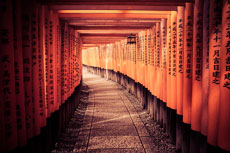
  • Torii
    Entrance gate to a Shintō shrine.
  • Tosa
    Former name of Kochi prefecture.
  • Tramp (or torampu)
    Playing cards (the word comes from "trump"). Not a homeless person, nor a promiscuous woman.
  • Tsuba
    Sword guard as used on "katana".
  • Tsubaki
    Camellia. One of the most common flowers in winter in Japan.
  • Ukai
    Cormorant fishing. This has been practice for a very long time in Japan and can still be observed in some rural areas such as the Gify prefecture (see Inuyama.
  • Ume
    Japanese plum (or abricot). It looks like a big, green apricot and is used principally to make "umeshu" or "umeboshi"
  • Usagi
    Rabbit. One of the most loved animal in Japan. It is used as a mascot by NOVA, and many hostess bar have "bunny girls".
  • Wa
    Concept of harmony and team-spirit. The kanji (˜a) can also be read as "Yamato", meaning "Japan". It is the 'Wa' used in Wa-pedia.
  • Yakuza
    Japanese mafia
  • Yamabushi
    Mountain priest, practitioners of the Shugendo sect of Buddhism.
  • Yamagata Aritomo
    Prominent Meiji-era statesman and founder of the modern Japanese army. He served twice prime minister.
  • Yomiuri Giants
    Most popular Japanese baseball team (from Tokyo), supported by about 50% of the Japanese.
  • Zabuton
    Flat cushion used for sitting on.
  • Zaibatsu
    Industrial conglomerate, such as Mitsui, Mitsubishi or Sumitomo.

Famous historical people of the last 150 years

  • Emperor Meiji (Mutsuhito)
  • Emperor Taisho (Yoshihito)
  • Emperor Showa (Hirohito)
  • Emperor Akihito
  • Katsura Taro
  • Inoue Kaoru
  • Ito Hirobumi
  • Matsukata Masayoshi
  • Natsume Soseki
  • Okubo Toshimichi
  • Okuma Shigenobu
  • Matthew C. Perry
  • Saigo Takamori
  • Saionji Kimmochi
  • Yamagata Aritomo


  • Site Sections

  • Japan Forum
  • Japan Photo Gallery
  • Japan Travel Guide
  • Practical FAQ
  • Life & Work in Japan
  • Expat Life
  • Economy of Japan
  • Statistics about Japan
  • Site Sections

  • Cultural Guide
  • Cultural Glossary
  • History of Japan
  • Religion in Japan
  • Politics of Japan
  • Japanese Language
  • Japanese Friends Finder
  • Japanese Pop Culture
  • Associated & Recommended

  • Eupedia
  • Europe Travel Guide
  • Visual Guide of Japan
  • Topsites Japan
  • Japanese-English Dictionary


  • Copyright © 2002-2010 Wa-pedia.com All Rights Reserved
    About Wa-Pedia - Contact Wa-pedia - Site Help - Privacy Statement - Terms of Use