Nagoya Castle 名古屋城
Built in 1612 by the ubiquitous Tokugawa Ieyasu for his ninth son, Nagoya-jō is a typical example of plain castle with defensive moat. The castle was the residence of the Owari branch of the Tokugawa family until 1867.
American air raids in the late months of WWII only left a pile of rubble on the spot. What you see today is a 1959 ferro-concrete reconstruction with an elevator (lift) inside. The Honmaru Palace, where the shogun took quarters on official visits in Nagoya, was not rebuilt, but a model replica can be seen in the castle museum.
The castle is famed for its two golden dolphins perched at each extremity of its roof. They have become true symbols of Nagoya and appear on most souvenirs. Each of them weights approximately 1,200 kg (2,500 lb).
The Ninomaru Gardens are quite large and attractive during the cherry blossom or autumn leaves season, although they clearly lack maintenance. Weeds grow almost uncontrollably, even with the few deers grazing in the moat.
Tickets (adults ¥500) can be purchased either at the main gate (south-west) or east gate. More information on the official website.
Tokugawa Art Museum 徳川美術館
Ancestral fief of the Tokugawa family, Nagoya remained the domain of the Owari branch after Tokugawa Ieyasu rose to become shōgun in 1603. It is inside the old residence of these Owari Tokugawa lords that is housed the Tokugawa Art Museum. Samurai lovers will be delighted. The museum has a paraphernalia of everything a daimyo or samurai could have possessed or wished for : superb armours and helmets, finely crafted swords, but also more mundane objects like ceramic tea bowls, porcelain inkstones, beautiful food containers, incense burners... There are Noh masks and robes, Edo-era furniture and paintings. The gem of the collection is the illustrated scrolls of the Tale of Genji, dating from the early 12th century and designated National Treasure. The scrolls are among the oldest and most valuable Japanese paintings. Their fragility prevents them to be continuously on display. The originals are normally shown to the public only one week per year, but photographs and modern reproductions are on permanent display.
Ōsu Kannon Temple 大須観音
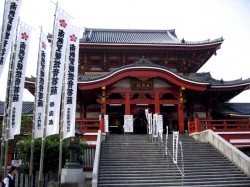
Relocated in 1612 from Gifu prefecture to central Nagoya by Tokugawa Ieyasu (him again), Ōsu Kannon is probably the most interesting Buddhist temple in Nagoya. Dozens of smaller temples and shrines are scattered around. Shopping in Nagoya in an entirely different experience from Ginza or Shinjuku. You can sample that quaint provincial feeling at the Ōsu Shopping Arcade, named after the temple.
An antique market is held at the Osu Kannon on the 18th and 28th of each month.
Atsuta-jingū Imperial Shrine 熱田神宮
Set in a grove 5 km south of Nagoya station, surrounded by venerable and dramatic-looking cypress trees, Atsuta Jingū is one of the most sacred Shintō shrines in Japan. It is one of the three Imperial Shrines of State Shintō, along with Ise Jingu in the adjacent Mie prefecture and Meiji Jingu in Tokyo. It is said to have been founded in the 2nd century (this cannot be confirmed as writing was only adopted in the 5th century in Japan).
Atsuta Jingū houses the sword Kusanagi no tsurugi (草薙の剣, "grass-cutting sword"), which is one of the the three Imperial Regalia (三種の神器, "sanshu no jingi"). The two others are the mirror in Ise Jingu and the jewels in Meiji Jingu. The sword, also called ame no murakumo no tsurugi was given by the Sun Goddess Amaterasu to her grandson to fight an evil kami who had taken the shape of a giant snake. The sword, however, is never on public display (perhaps to preserve its spiritual mystery).
Atsuta Jingu can be accessed by subway (Meijō line, Jingu Nishi Station), JR Tōkaidō line (Atsuta Station) or Meitetsu line (Jingu-mae Station).
Map of attractions in Nagoya