One of the prides of the shrine is its "ichi-no-miya" mikoshi, the biggest "mikoshi" in the Kanto region, weighing 4 tonnes. This mikoshi is actually too heavy to be carried during the festival. Another reason is its value. It is decorated with diamonds, rubis and saphires, and cost a startling one billion yen.
The shrine is a short walk from Monzennakachō Station (Tozai-line or Oedo-line). Take the exit number 1 or 6, then walk east past the Fukagawa Fudoson.
The Fukagawa Hachiman Matsuri (see photos in gallery) is one of Tokyo's "big three", along with the Sanja Matsuri (Asakusa) and the Kanda Matsuri. 55 "mikoshi" (portable shrines), representing all of Fukagawa's districts, are carried on the main avenue "Eitai Dori" (Tokyo's road leading from the Imperial Palace eastwards to Chiba prefecture).
The festival is held once every three years in mid-August (last in 2002) and brings an estimated 500.000 onlookers and 30.000 participants. It was nicknamed the "water-throwing festival" ("mizu-kake matsur"i), as spectators happily throw water on the mikoshi carriers to refresh them of the heat of summer.
Fukagawa Fudōson Temple (深川不動尊)
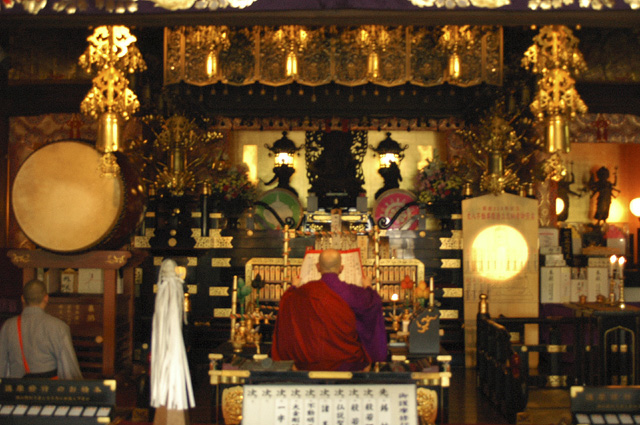
Right outside Monzennakachō station's exit 1, the red Narita-san gate will lead you to the Fukagawa Fudōson Temple (深川不動尊) of the Shingon sect, another significant attraction and probably the most interesting Buddhist temple in the area. The temple was first built in 1703 and is a branch of the Narita-san Shinshō-ji Temple near Tokyo International Airport. The present building dates from 1881.
A flea market is held between the Fudōson and Hachimangū every 1st, 15th and 28th of each month.
Fukagawa 深川
The neighbourhood officially called Fukagawa is much smaller than the vast area extending from Eitai-bashi Bridge to Tōyōchō and Morishita. It is located between Monzennakachō and Kiyosumi-Shirakawa stations.
To go there from Monzennakachō, take the Kiyosumi-dōri northward, pass Akafudadō supermarket and under the elevated expressway. You will arrive at the intersection of Kasaibashi-dōri, which is Fukagawa 2-chōme.
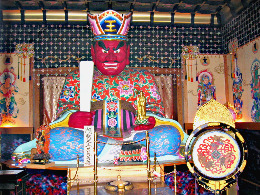
This area contains a few good temples around the crossing. Right on the corner, the Hōjō-in Temple (法上院), established in 1629, hosts the Enma-dō (閻魔堂; "Hall of the King of Hells"). Don't miss the exuberant 3.5m tall statue of Enma-sama, the Buddhist dharmapala and judge of the dead who presides over the Buddhist Hells. The Buddhist Enma (or Emma) is based on the god Yama of the Hindu Vedas. He is particularly venerated in Esoteric Buddhism, like the Japanese Shingon sect and Tibetan Buddhism.
Backtracking to the intersection, take the Kasaibash-dōri and you will come across the Genshin-ji Temple 1min from the corner. Going back to the Kiyosumi-dōri, on the other side of Hōjō-in, the Shinkō-ji temple is particularly beautiful in autumn when its ginko trees are all yellow.
If you continue walking a few minutes northward on the Kiyosumi-dōri, you will reach Miyoshi and Shirakawa on your right and the Kiyosumi Garden on your left.







 Dating back to the Edo era, the gardens are believed to have been the residence of business tycoon Kinokuniya Bunzaemon. The residence passed to Kuze-yamatonokami...
 The largest park in the Kōtō Ward, it is home to the Tokyo Museum of Contemporary Art...


